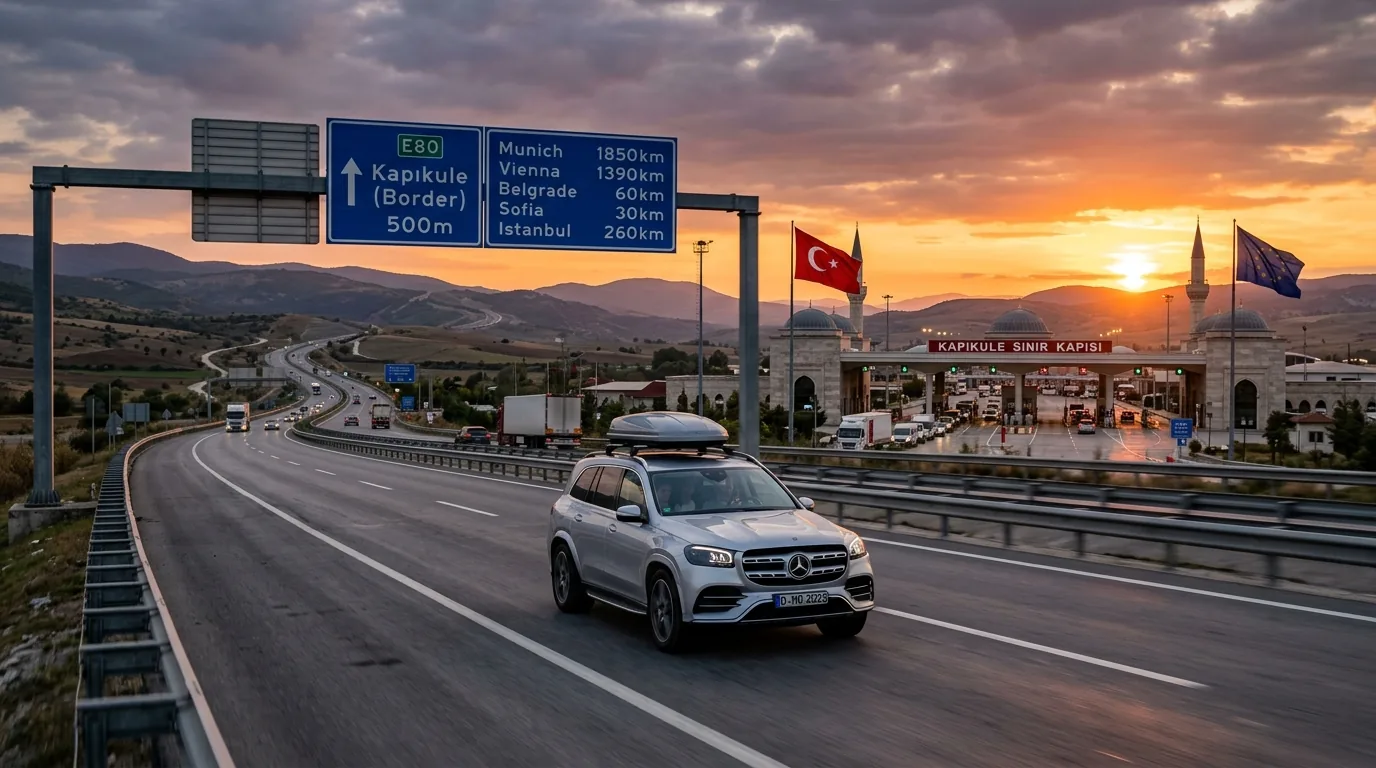

Every summer, hundreds of thousands of European expatriates, diaspora families, and road-trip adventurers embark on the legendary overland trek to Turkey known culturally as the Sıla Yolu. Traversing between 2,200 and 3,500 kilometers from Western Europe (Germany, Austria, Netherlands, France, Switzerland) across Central Europe and the Balkans toward the Turkish border posts of Kapıkule or İpsala is a thrilling epic journey. However, strict international customs laws, computerized vignette toll systems, and border queues require meticulous preparation in 2026. This comprehensive guide covers the two primary transit corridors, country-by-country vignette fees, live border webcam strategies, and Turkey's mandatory 185-day customs rule.
1. The Two Main Road Corridors: Serbia vs. Greece Route
Drivers traveling to Turkey primarily choose between two established highway arteries:
A) The Classic Balkan Route (Germany - Austria - Hungary - Serbia - Bulgaria - Kapıkule):
- Distance & Driving Time: Approx. 2,100 km from Munich to Edirne (22 to 26 hours of pure driving).
- Pros: Over 98% multi-lane divided motorway; lined with specialized Turkish diaspora rest areas, halal food, and prayer facilities.
- Cons: Exits the Schengen Zone twice (entering/exiting Serbia), creating border bottlenecks that can stretch from 4 to 8 hours at Röszke and Kalotina during peak summer weeks (July & August).
B) The Southern Greek Corridor (Germany - Austria - Slovenia - Croatia - Serbia - North Macedonia - Greece - İpsala):
- Distance & Driving Time: Approx. 2,250 km from Munich to İpsala.
- Pros: The modern Egnatia Odos highway across northern Greece is exceptionally smooth and scenic. The İpsala border crossing into Turkey is substantially less congested than Kapıkule.
- Cons: Numerous barrier toll stations across Greece and Croatia, resulting in slightly higher cumulative out-of-pocket toll costs.
2. 2026 Country-by-Country Vignette & Highway Toll Matrix
To avoid severe electronic radar fines, secure digital vignettes in advance through official government portals:
| Transit Country | Toll System Type | Standard Tourist Rate (2026) | Official Purchasing Portal |
|---|---|---|---|
| Austria | Digital or Adhesive Vignette | €11.50 (10-Day Pass) | ASFINAG official portal / border kiosks |
| Hungary (Matrica) | Electronic e-Matrica | ~€16.50 (6,400 HUF / 10 Days) | nemzetiutdij.hu (Official site) |
| Serbia | Distance-Based Barrier Tolls | Total ~€22.00 (One-way transit) | Pay at booths via contactless card or EUR cash |
| Bulgaria (BGTOLL) | Electronic e-Vignette | ~€8.00 (15 BGN / Weekend or 7-Day) | bgtoll.bg (Official Ministry site) |
| Slovenia | Electronic e-Vinjeta | €16.00 (Weekly) | evinjeta.dars.si |
| North Macedonia | Cash/Card Toll Plazas | Total ~€8.00 | Pay at barrier gates |
| Greece (Egnatia Odos) | Distance Toll Plazas | Total ~€15.00 | Pay at automated and manned booths |
3. Navigating Turkish Border Crossings & Live Webcam Strategies
During the peak diaspora rush in July and August, queues at Kapıkule can stretch for miles. Use these smart crossing strategies:
- Monitor Live Customs Cameras: The Regional Directorate of Customs maintains live streaming cameras covering all processing lanes at
trakya.ticaret.gov.tr. - Strategic Border Alternatives:
- Hamzabeyli (Bulgaria exit): Located 40 km north of Kapıkule; highly effective bypass when Kapıkule is gridlocked.
- Dereköy (Bulgaria / Malko Tarnovo): Scenic winding forest road through Strandzha; rarely has long queues.
- Pazarkule (Greece / Kastanies): Modernized border terminal just 5 km from Edirne city center.
- İpsala (Greece / Kipi): The premier choice for travelers heading to the Aegean coast, Çanakkale Bridge, or western Istanbul.
4. Mandatory Documents Required at the Turkish Border
- Vehicle Registration Certificate (Logbook): Proving vehicle ownership and technical specifications.
- International Green Card Insurance: Your motor insurance policy must explicitly cover Turkey without the "TR" code crossed out. If excluded, you must purchase a local third-party border policy at the customs gate.
- Power of Attorney (Vekaletname): If the vehicle is leased, company-owned, or registered under a relative's name, you must hold a certified Turkish consular or notarized power of attorney authorizing you to drive the car into Turkey.
- Passports & ID Cards: Valid for at least 6 months beyond your travel date for all passengers.
5. Setting Up Turkey's HGS Toll Tag
All motorways, bridges, and tunnels in Turkey operate on the automated HGS (Hızlı Geçiş Sistemi) RFID tag system. Upon crossing the border at Kapıkule or İpsala, stop at the 24/7 PTT post office booth located inside the customs compound. Present your vehicle registration document to purchase an adhesive HGS windshield sticker pre-loaded with credit in under 5 minutes.
Frequently Asked Questions (FAQ)
2026 Strategic Field Guide: Route Planning, Highway Clearances, and Local Transit Logistics
Navigating cross-border highways, regional motorways, and transit hubs across Turkey and neighboring corridors in 2026 necessitates proactive logistical foresight. Peak seasonal influxes—notably summer holiday migrations and national celebration weekends—can generate extensive bottlenecks at electronic toll barriers, customs border gates, and major maritime ferry terminals. Actively monitoring live traffic feeds, ensuring electronic toll clearinghouse accounts (such as HGS or regional digital vignettes) possess sufficient pre-funded reserves, and charting secondary detour arteries significantly alleviates transit stress and curtails fuel consumption.
Furthermore, when traversing mountainous topography, national reserves, or remote canyon passages, mobile cellular reception may attenuate. Having full offline navigational cartography cached on your device, cataloging verified coordinates for emergency waypoints, and maintaining essential mechanical road supplies (such as a portable digital tire compressor and certified first-aid provisions) represents standard international best practice.
Official 2026 Traveler & Motorist Operational Checklist
- Toll Verification & Vignette Procurement: Acquire digital vignettes and HGS registrations exclusively via verified governmental clearing portals prior to traversing toll segments.
- Offline Navigation Caching: Pre-download all regional satellite tiles, accommodation markers, and emergency services onto local device memory.
- Mechanical Vehicle Inspection: Ensure comprehensive servicing of brake systems, tire tread depths, and coolant reservoirs prior to long-distance journeys.
- Currency Billing Precision: Always instruct merchant POS terminals to bill transactions in local fiat currency to prevent aggressive DCC (Dynamic Currency Conversion) markups.
- Emergency Support Services: Store relevant infrastructure hotlines including KGM Road Advisory (159) and Universal Emergency Response (112) in your mobile directory.
4 Critical Pitfalls to Avoid in 2026
Field data highlights four frequent operational mistakes made by international applicants and travelers, along with expert mitigation strategies:
| Risk Factor | Common Misconception | 2026 Verified Best Practice |
|---|---|---|
| Document Recency | Assuming certificates never expire | Ensure police checks and banking records are under 90 days old |
| Payment Trails | Transacting in unrecorded cash | Channel all fees through electronic banking with explicit reference IDs |
| Address Registration | Treating temporary rentals as permanent | Formally register your residential lease with municipal civil registries |
| Unauthorized Agents | Relying on unsolicited social media offers | Interact solely through official ministerial portals and accredited bodies |
How long can a foreign-plated car stay in Turkey?
Under Turkish customs law, a foreign-registered private vehicle can remain in Turkey for a maximum of 730 days (2 years), provided the owner meets the 185-day foreign residency requirement.
How is the 185-day foreign stay requirement calculated?
Customs officials calculate your physical days abroad looking back exactly 365 days from the date of your border arrival. You must have spent at least 185 days outside Turkey during that one-year window.
Can I drive a company car or leased vehicle to Turkey?
Yes. However, you must present a notarized and apostilled power of attorney from the leasing company or employer authorizing your trip. Company vehicles are generally granted a shorter initial stay (30 to 90 days).
How strictly are speed limits enforced along the Balkan corridor?
Extremely strictly. Serbia enforces average sectional speed cameras between toll plazas (130 km/h limit), while Bulgaria has widespread electronic speed traps. Fines must be paid on the spot via terminal.
Where should I purchase the Bulgarian road vignette?
Buy your Bulgarian vignette exclusively on the official government website bgtoll.bg prior to reaching the border to avoid rogue roadside kiosks charging inflated fees.
What happens if I pass a Turkish toll booth without an HGS sticker?
You have a 15-day grace period to purchase an HGS tag from any PTT branch and load sufficient funds. As long as you register within 15 days, toll charges are deducted normally without punitive fines.